What's shipped, what's next.
Every release, version by version. Plus a curated list of upcoming features once they're locked in.
v1.4.2-beta Auto-updater fix + Graphify/MemPalace are optional May 2026
Fixed
- Auto-updater works for prerelease users again. The v1.2.1 "channel pin" fix was actually the bug — pinning the channel to
latestcaused electron-updater's tag-discovery step to skip every prerelease in the feed silently, so the updater threwERR_UPDATER_NO_PUBLISHED_VERSIONSand no banner ever appeared. Every prerelease user from v1.2.1 through v1.4.1 was affected. Dropping the pin lets the updater fall through tolatest.ymlcorrectly.
Added
- Auto-updater is now observable. The update banner renders all five states (checking, available, downloading with progress %, downloaded, error with Retry). A log file at
%APPDATA%/Foundry/logs/updater.logcaptures every updater event for diagnosing silent failures. The initial-check delay dropped from 15s to 5s. - Settings: an "App updates" panel with installed version and a manual "Check for updates" button.
- Settings: an "Optional MCP servers" panel for installing Graphify and MemPalace from outside the wizard, with the same streaming install experience.
Changed
- Graphify and MemPalace are optional now, not required. The full-screen install gate that blocked the app on launch is gone. Both retiered from
requiredtorecommended; users discover and install them from Settings when they want them. Both degrade gracefully at runtime: the MemPalace bridge is fire-and-forget safe and the Scholar prompt has codebase-graph signals sealed off via the existing review boundary.
v1.4.1-beta Windows install-gate hotfix May 2026
Fixed
- Install gate no longer hard-locks Windows users whose Python is reachable only via the
pylauncher. The graphify and mempalace install routes were running the registry's barepip install …andpython -c …commands directly, bypassing the python-runtime normalization the rest of Foundry uses. On Windows machines where Python is installed via the python.org installer's default path (barepipisn't on PATH, butpy -3 -m pipis), preflight passed but the actual install steps exited with code 1 and users were stuck on the gate. Both install routes now detect the canonical interpreter and rewrite each step before running.
Added
- "Skip for now" escape hatch on the install gate's error state. Defense in depth so users with broken Python setups aren't permanently locked out. Skipping persists across launches; users run with degraded features (no codebase analysis, no semantic memory) and can re-install from Settings any time.
v1.4.0-beta Routines: scheduled tasks for Claude Code Desktop May 2026
Added
- New Routines bucket in Forge. Compose existing agents into a routine, set a schedule, pick required connectors (cloud MCPs like Gmail, Slack, Notion or local stdio servers), and choose project or global scope. Routines deploy to
~/.claude/scheduled-tasks/<slug>/SKILL.mdfor Claude Code Desktop to pick up. - Connector-aware scheduling. Foundry queries
claude mcp listto detect what is installed and shows a status chip per required connector. Missing connectors warn you before deploy. If a connector disappears after deployment, the routine's card shows a failure-recovery banner. - Active/Draft lifecycle. Build a routine as a Draft, click "Test it" to copy a runnable command with the correct CWD, Deploy when ready. Undeploy or edit any time without losing the definition.
- Four starter templates ship in the Routines bucket.
- Scholar can propose routines via a new
propose_routinetool inside the Routines bucket conversation. - Project vs. global scope on every routine via user-chosen visibility tags.
- "Keep my routines" toggle in reset. Routines are machine-global, so the reset/nuke dialog now has an explicit opt-out before wiping them.
- Apify capability registered as a recognized connector.
Fixed
- HTTP-transport MCP
apiKeySetdetection corrected. Status chips now reflect configured keys correctly. - Local stdio MCP servers health-check correctly. Connector detection now passes
projectPath, so local stdio servers no longer always appear as unavailable. test-itcommand sets CWD correctly. The copied test command usescd <path> &&rather than--add-dir, so it runs in the expected project context.
v1.3.0-beta Graphify guidance reaches the orchestrator May 2026
Added
- SessionStart hook tells the orchestrating Claude to query graphify before grepping. Without it, Claude saw graphify as registered MCP tools but had no instruction to use them proactively, so it defaulted to grep/read across unfamiliar files. Hook is managed, idempotent, and removed cleanly on reset.
.graphifyignoreis written to your project on first scan. Mirrors the in-process skip list (node_modules,.next,dist,build,vendor, etc.) so the post-commit graphify update skips the same directories. Idempotent: never overwrites a file you have edited.- Post-commit summary regen. A new shim and a markered Foundry block in
.git/hooks/post-commitkeep the auto-loaded codebase summary fresh after every commit. Closes the staleness loop: graphify rebuilds the graph on commit, the shim immediately refreshes the summary file Claude sees on every turn.
Changed
- The auto-loaded codebase summary now addresses the orchestrator directly. Previous wording read as delegation-gated and steered the main thread away from using graphify itself. The new copy is a direct project rule: query graphify before exploring 3+ unfamiliar files, local tool, no token cost.
Fixed
- Settings to "Refresh code graph" now refreshes the summary file too. Previously the manual refresh button rebuilt the graph but left the auto-loaded summary stale until the next full wizard or analyze run.
- Wizard-init scan path now installs graphify's git hooks for parity with the analyze path. Without this, a project initialized via the wizard never got post-commit auto-rebuild.
v1.2.3-beta Documentation Enforcement gains a procedural runbook April 2026
Added
- Documentation Enforcement now scaffolds a step-by-step runbook. Enabling the toggle drops a third doc-bootstrap file alongside the index and standards:
documentation-runbook.md, a five-step procedure (blast radius, update vs. create, write, index update, stamp) with a concrete exit condition on every step. Existing users see no overwrites; the runbook appears on next re-apply or fresh enable.
Changed
- The always-loaded rules file is now a thin pointer layer. Methodology no longer lives in the rules file; it points at the index, the standards (WHAT), and the runbook (HOW), plus the load-bearing rule that topic content lives in your docs folder, never in CLAUDE.md. Pre-commit checklist consolidated into the runbook so there is exactly one canonical version.
- The post-write hook nudge now references the runbook by path. When Claude finishes writing a structural change, the advisory points at the runbook procedure rather than asking it to "update or create a doc."
v1.2.2-beta Shared context imports healed April 2026
Fixed
- CLAUDE.md managed block now references shared resources that actually exist. The block was hard-coding a reference to a file Foundry never writes, so every freshly-init'd project shipped with a broken import that Claude Code silently skipped. The @-ref list is now derived from the resource manifest, so it always matches what is on disk.
- Shared-resource writes now auto-refresh the managed block. Adding a new shared resource via any Foundry init or agent path immediately updates the @-refs in CLAUDE.md without waiting for the next Save Team.
- Empty-roster projects keep their shared @-refs. A project with shared context docs but no agents now correctly retains those imports instead of stripping the entire block.
Added
- App-startup project sweep. On launch, Foundry rebuilds the CLAUDE.md managed block for every known project from its current resource manifest. Heals any project that existed before the auto-refresh wiring landed.
v1.2.1-beta Auto-updater fix April 2026
Fixed
- Auto-updater now reliably detects and delivers updates. A channel-detection bug in
electron-updatercaused the updater to look for abeta.ymlmanifest that was never published, silently reporting "no update available" on every check. This has been present since the first beta. The fix pins the channel tolatest.ymland enables prerelease-to-prerelease update delivery.
v1.2.0-beta Cleaner reset and full init visibility April 2026
Added
- Foundry self-introduces at init. A context note is written into Claude Code's per-project memory directory so agents working in a Foundry-managed repo immediately know which
.claude/files are machine-local and which are committed source. Stops agents from trying to commit runtime files.
Fixed
- Existing agents show up in the Forge during init. Agents already on disk in
.claude/agents/now appear in the agents bucket alongside Scholar's proposals, tagged "existing" and deduped by name. Previously an on-disk agent could go invisible during init. - Reset and uninstall leave zero trace. The
# >>> foundry >>>fence is stripped from.gitignoreand Foundry's self-introduction is removed from Claude Code's per-project memory. CRLF-safe on Windows.
v1.1.1-beta Documentation Enforcement: modular docs scaffold April 2026
Changed
- Documentation Enforcement scaffolds a real docs structure on enable. The toggle now writes two starter files into your docs folder if absent: a skeleton
README.mdindex and a fulldocumentation-standards.mdmethodology doc (stamp format, citing rules, sister-repos guidance, "topic content goes in topic docs not CLAUDE.md"). The.claude/rules/foundry-doc-currency.mdrules file is now a thin pointer (~30 lines) instead of a self-contained ~70-line reference. Once Foundry writes those starter docs, you own them: edit freely, Foundry never overwrites or removes them on toggle disable. - Existing users: the new shape applies on next toggle re-apply. Resave the toggle in Foundry Settings to pick up the scaffold.
Internal
- New
BehaviorManifesttype'doc-bootstrap'for write-once scaffolding (write only if absent, never overwrite, never remove on cleanup). Reusable for future toggles that seed user-owned content.
v1.1.0-beta Cost-aware hooks, install-time linting, zero-hook fresh installs April 2026
New
- Firing-rate badges. Every hook starter template carries a cost-profile badge (
session-start,per-tool-call, etc.) so you see how chatty a hook is before installing. - Static-text linter. When a
PreToolUseorPostToolUsehook just echoes constant text, the editor surfaces a soft-warn banner suggestingSessionStartinstead. Claude absorbs the message once, not on every tool call. - Hook prerequisite probe. Templates can declare required files; if any are missing on disk, the install flow warns before proceeding.
- Stale toggle ID detection. Global Settings now flags behavior toggles removed in a Foundry update so you can clean them up with one click.
Changed
- New hooks default to
SessionStart. Cheapest-fires-first by default;PreToolUseremains available for gating patterns. - doc-currency moved to
SessionStart. Previously fired on every read-type tool call (~30 redundant injections per session); now fires once. - Standing Order Gate installs conditionally. Empty teams now write zero hooks. Removing the last standing-orders agent or memory-capable agent and re-initing actually cleans up the obsolete hook registrations and helper scripts.
Fixed
- Fresh installs no longer ship redundant hooks. Prior versions auto-installed 4 system hooks + 3 helper scripts at every init regardless of agent state.
- Settings drift on agent removal. Old hook registrations no longer persist in
settings.jsonpointing at deleted scripts.
v1.0.1-beta Patch: reset hygiene, Electron data bundling, Scholar UI polish April 2026
Fixed
- Reset cleanup is complete. Reset Project now also clears
foundry-baselines.json, so baseline state doesn't drift across a reset. - Behavior cleanup strips everything. Disabling a behavior toggle now removes all four artifact types (settings.json hook entries, settings keys + sidecar, and
.claude/hooks/foundry-*.mjsfiles). - Packaged builds load all data. The Electron installer now bundles
data/runtime files into the standalone server, fixing bucket registries that silently failed to load. - Scholar UI fills the column. The collapsed FAQ rail uses a single icon and fills its height; the chat panel now fills the full viewport.
- Doc-currency behavior, three small fixes. Custom stamp templates are validated, stdin handling is fixed, and
.mjshook scripts deploy correctly.
Changed
- Auto-updater follows the org. Release publishing and the in-app updater now point at
try-foundry/tryfoundry-releases.
Removed
- Re-scan project (legacy). The dead Re-scan path is gone from both entry points.
v1.0.0-beta Baselines, templates, and path-scoped behaviors April 2026
Headline Features
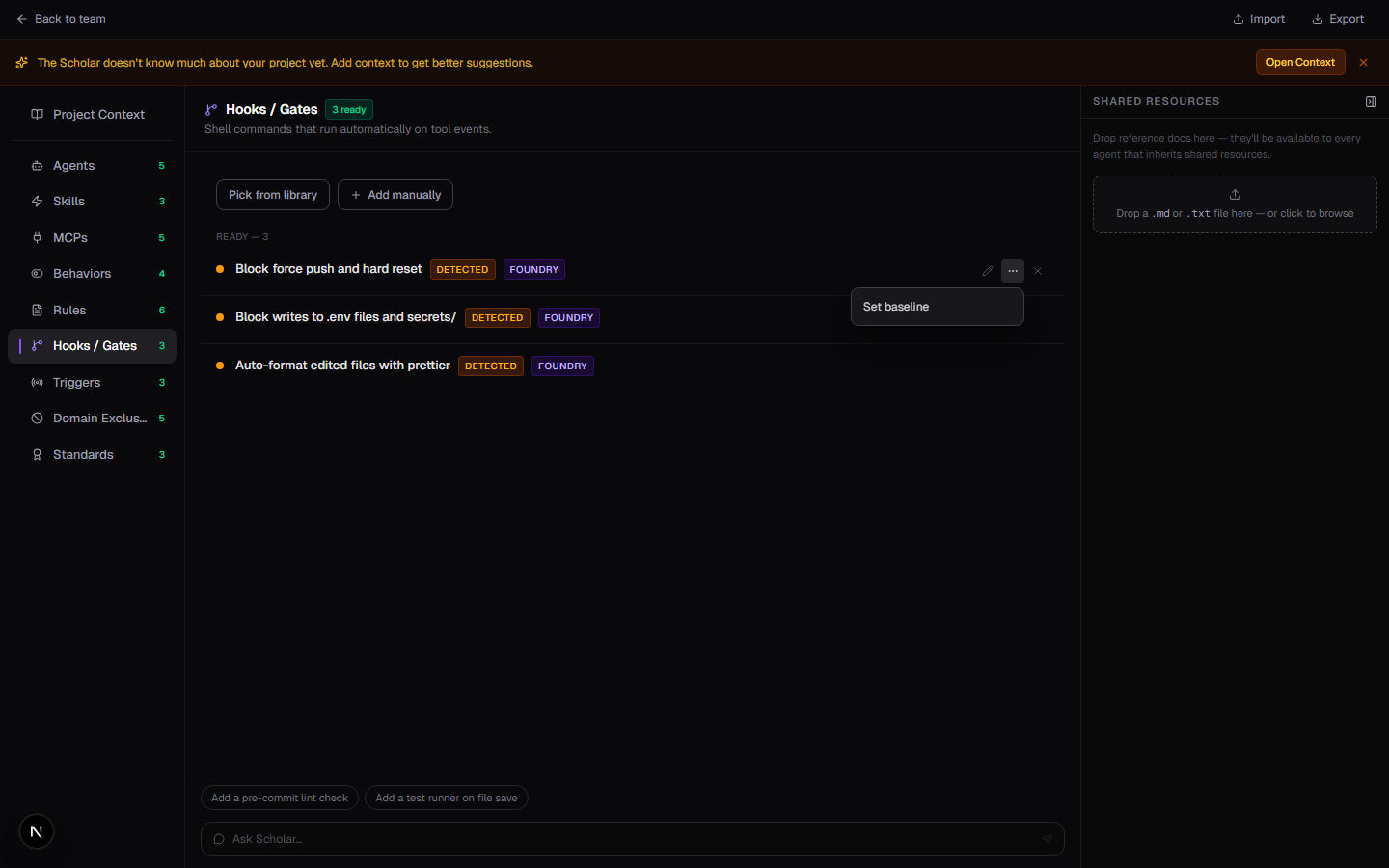
- Per-item baselines. Every Foundry-managed item auto-captures its first deployed state. One click to reset if a Scholar revision goes sideways; one click to update when you settle on a new good state.
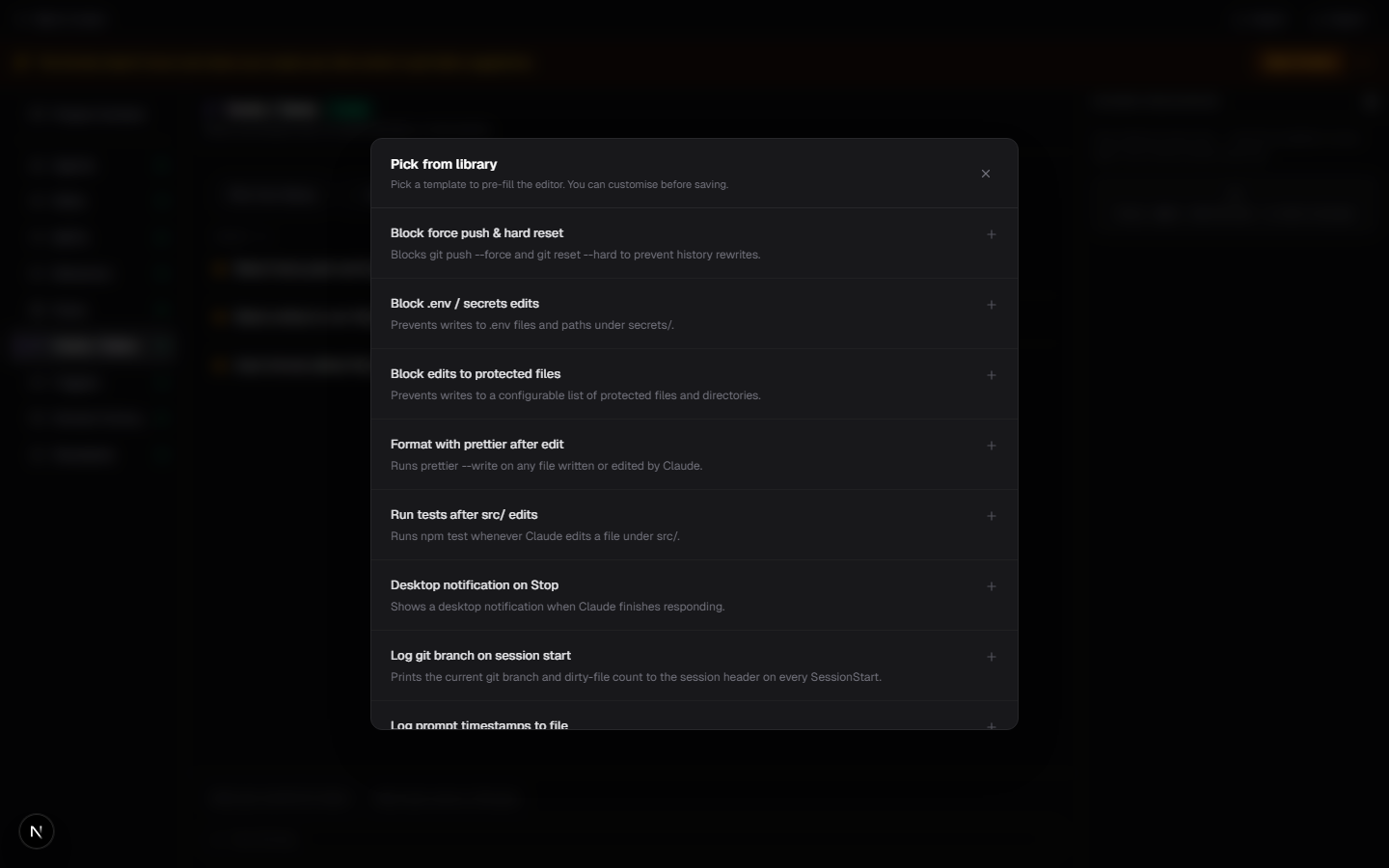
- Templates everywhere. Every bucket (hooks, agents, triggers, skills, rules, standards) now has a Pick from library modal with curated starters, plus an inline pill row in each editor for fast inserts.
- Path-scoped behaviors. All 29 behavior toggles support file glob scoping. A "Write tests in TDD style" rule fires only when Claude touches test files, keeping prompt payloads lean for focused work.
Quality and Reliability
- Reliable persistence. Standards and rules save correctly across both the wizard and disk-mode editor.
- Stable identities. Hooks and triggers carry stable IDs so baselines survive a reload.
- Atomic writes. The
.claude/tree writes atomically; no more half-written files on crash. - Failure transparency. When Scholar generation fails, you see why instead of a silent fallback.
- Browseable reasoning. Mid-flow Scholar reasoning is accessible via a dedicated modal.
- Better diffs. Agent diffs now surface model, effort, and disallowed-tools changes that previously applied invisibly.
v0.9.0 Forge editor, 2x2 taxonomy, and interview overhaul March 2026
New
- Forge editor. A persistent dashboard for modifying your team config after initial setup. Every bucket editable in one place: hooks, agents, behaviors, triggers, skills, MCPs, and project context.
- 2x2 agent taxonomy. Agents now carry a role (Specialist or Guardian) and a kind (Worker or Scholar). Shown on every roster card and in every generated file.
- Interview overhaul. The onboarding interview is now a real conversation: 8 to 12 focused questions, developer-skill pills, and a natural back-and-forth instead of a form.
- Domain exclusions. Per-domain rules for where agents operate. Keeps test-only agents away from production paths.
Fixes
- MemPalace bridge deduplication removed dev console error spam.
- Wizard post-creation handoff state corrected after navigation changes.
- Tooling detection in the scope step now reports specific package names.
v0.8.0 Initial release: wizard, Graphify, and first agents January 2026
First Release
- Six-step wizard. Analyze, Scope, Interview, Brief, Approve, Install. From empty repo to running team in one pass.
- Graphify integration. Local codebase graph built on every commit. Agents query it instead of reading raw files, around 71x fewer tokens for structural questions.
- MemPalace memory. Decisions and conventions accumulate across sessions. The Historian files new knowledge; every agent can search it.
- Behavior toggles. Initial set of 20 toggles covering commit hygiene, planning gates, documentation checks, and standing-order controls.
- First agent roster. Code Reviewer, Security Guardian, Architecture Historian, Compliance Auditor, and Test Runner. All generated from your interview with role and kind already set.
Features committed for upcoming releases. No hard ETAs. They ship when they're ready, and the next release notes will tell you which ones landed.
Foundry 2.0
1
Foundry MCP server
Configure your agent team without leaving Claude Code. The Foundry engine exposed as an MCP server: install agents, update hooks, query your team from inside a session.
2
UX overhaul
A full visual and interaction redesign across every surface. Foundry 1.0 gets the engine right; the overhaul gets the feel right.
3
New Robots: card illustrations and branding
Distinct character illustrations for every agent role and quadrant position, plus updated robot branding throughout the app.
4
Font and style options
Choose your typography and visual style: font family, density, accent color. Foundry configures your tools. It should look like yours too.
5
Pause / resume any installed item
Temporarily disable a hook, rule, or behavior without deleting it. Resume restores it exactly as it was. Useful when you want to turn something off for a debugging session, then put it back.
6
Cross-project template library
Save any baseline as a reusable template. Future projects, and your other repos, pick it up automatically. Patterns you've already perfected, ready to drop into the next codebase without re-deriving them.
7
Multi-step undo per item
A persistent N-deep undo stack on every Foundry-managed item, in addition to the single-snapshot baseline. Walk back through Scholar revisions one at a time instead of jumping all the way to baseline.
8
Baseline diff view
When a live item diverges from its baseline, see exactly what changed inline. No more guessing whether to reset, update, or keep iterating. The diff tells you.
9
Per-agent domain exclusions
Each agent gets its own "stay out of these paths" list, prefilled from the project-wide exclusions and overridable. Lets you have a research agent that ignores
vendor/ while a build agent doesn't.Foundry 3.0
10
Portable agentic teams
Your Foundry team shouldn't be locked to one tool. In v3, Scholar designs a platform-agnostic agent team that exports to any AI coding assistant: Cursor, Windsurf, GitHub Copilot, and more. Same roles, same guardrails, same restore-points. One team. Every tool.